B2B SaaS + Vibe Coding = $1,000,000 ARR

I know you’ve read 1000s of articles about “Vibe Coding” and how it changes lives (or ruins them) already, but this one is going to be slightly different. After spending a year in this industry, I’ve realized that there’s two different types of vibe coding:
-
Vibe coding by individuals – usually done to chase startup dreams, 99% of which will never materialize. Characterized by a lack of domain insight or a real, pressing business problem to solve. I’ll call this “Unguided Vibe Coding” for the rest of the article.
-
Vibe coding by businesses, done for other business – a.k.a. “B2B Vibe Coding”. This is characterized by real business value created because it’s being done to solve a specific problem and uses domain knowledge from how a company operates. Traditionally, this was done by engineers, but as agentic AI is making advances, there’s a lot of time saved by doing it in an AI-first way.
I’m going to talk about the second kind in this one.
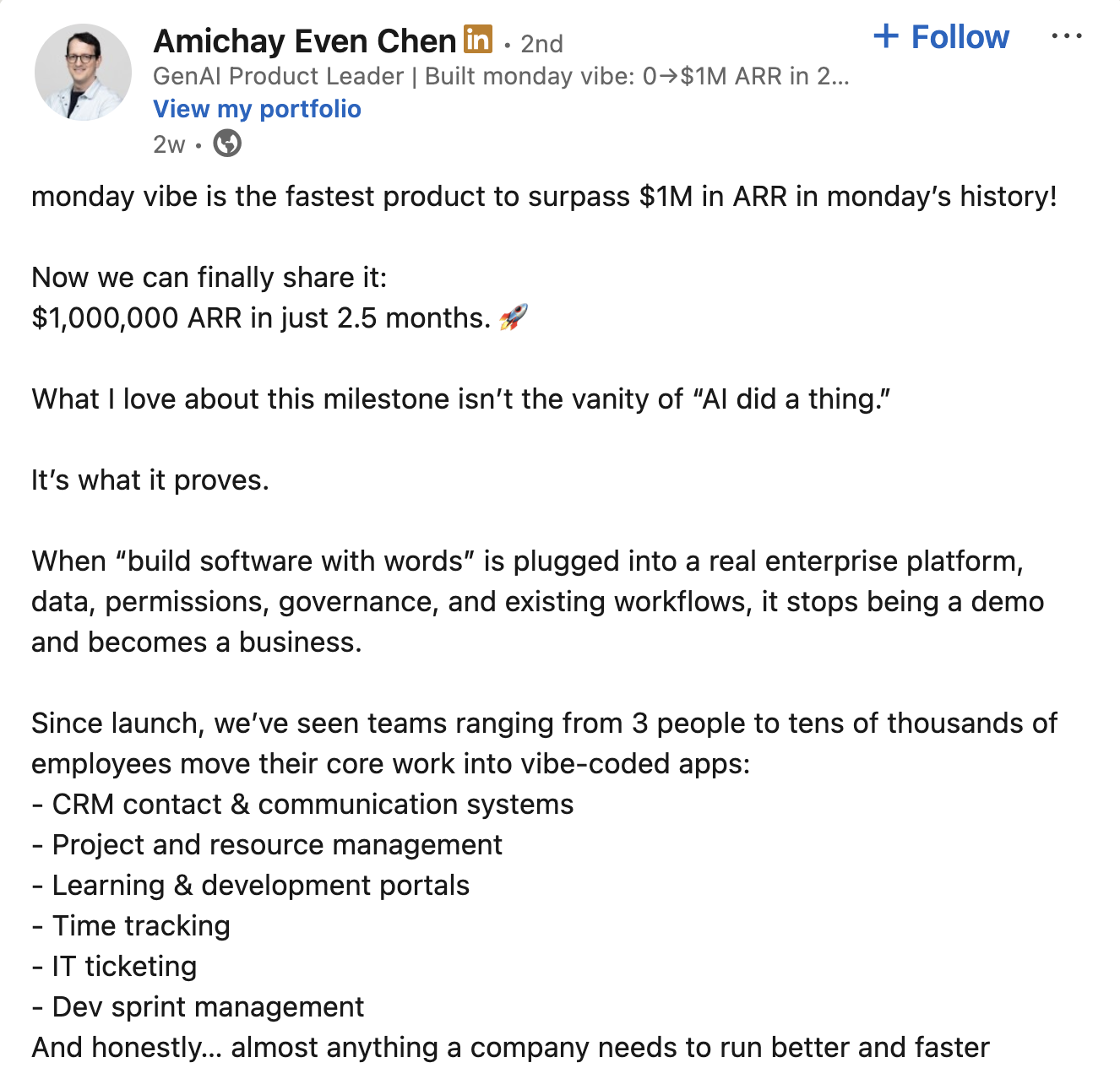
So, Monday.com just launched their fastest product to $1M ARR.
..and it just took them 2.5 months.
The kicker is that the product actually doesn’t do anything by itself in the traditional sense of the term – it just lets customers vibe code whatever they want on top of Monday’s platform.
From all the disdain we’re seeing about vibe coding lately, it’s astonishing what this one company has accomplished in such a short time.
Three weeks ago, I wrote about how AI is killing B2B SaaS. Stocks were (and still are) down 30%. The thesis was simple: customers can vibe code alternatives themselves, so why pay for inflexible SaaS?
Turns out, Monday.com figured out the answer. And it’s not what you’d expect.
The Anti-Product Product
While every other SaaS company is panic-adding AI features to their roadmap, Monday.com did something different. They built a vibe coding layer on top of their existing platform and called it a product.
And they got $1M ARR in 2.5 months… Their fastest launch ever.1
Let that sink in for a moment.
Product teams at most SaaS companies spend 6 months debating what features to build. Monday.com just gave users AI tools and said “you figure it out.”
And customers are eating it up.
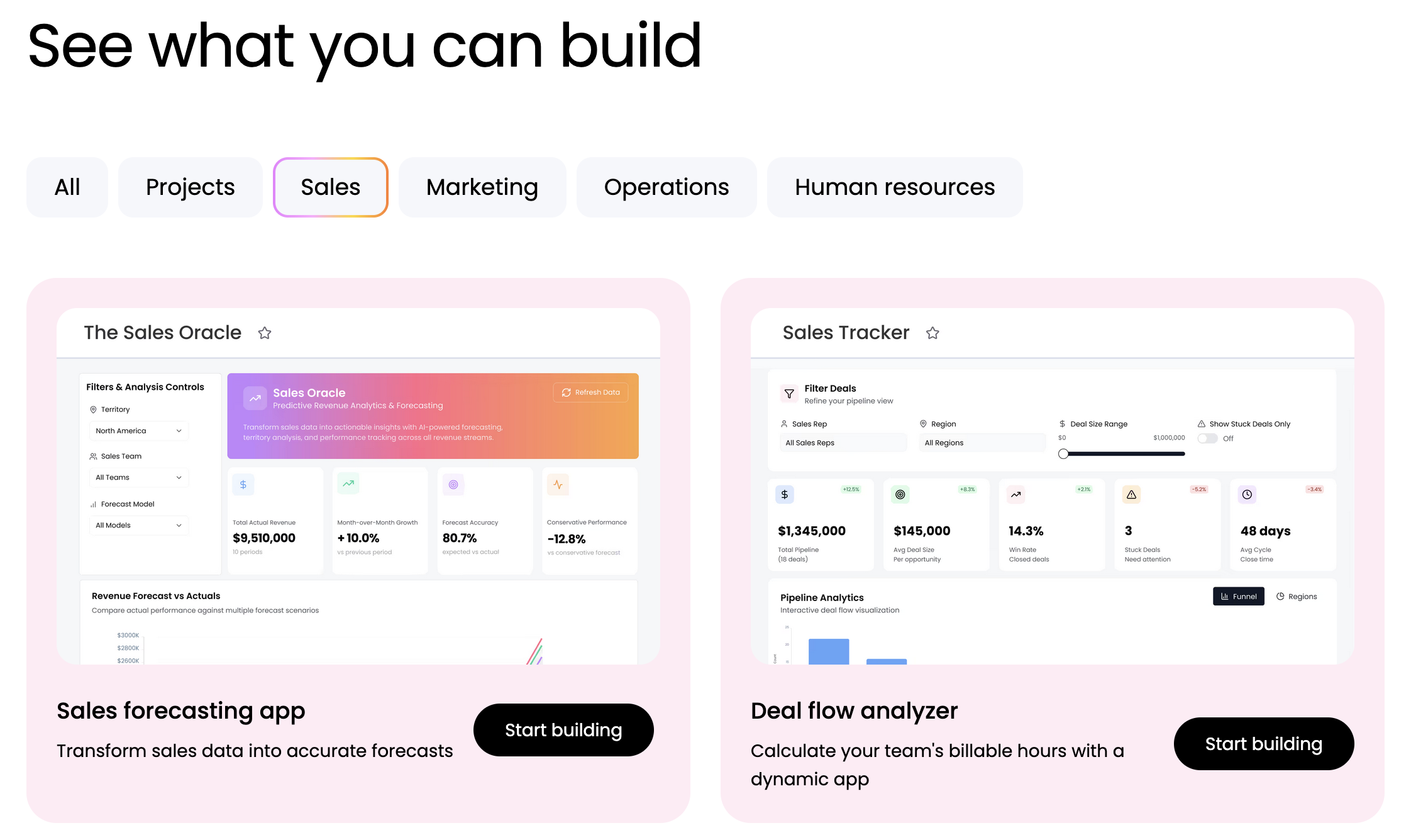
They’re building custom CRMs, project trackers, inventory systems, HR tools – things that would normally take quarters on an engineering roadmap. Now they’re shipping in days.
Why This Works
Here’s what Monday.com understood that everyone else missed: the future of SaaS isn’t better features.
It’s giving customers a vibe coding layer to build their own damn features.
There’s a quote I love from a SAP professor on HN:2
“I teach that changing the business to fit SAP is preferable to changing SAP to fit the business. And it’s accurate advice. It shouldn’t be, but it is. SAP is SAP. It doesn’t care about your USP. Or your custom approach to business.”
This is called “Fit-to-Standard” in business-speak. There’s an entire industry of consultants who charge hundreds of thousands of dollars to teach companies how to change the way they work to match their ERP.
It’s completely absurd when you say it out loud. But it’s also how B2B SaaS has made billions for decades.
Monday.com flipped it: Instead of making customers fit their business to the software, they’re letting customers build software that fits their business.
Moats in the age of AI
In my previous article, I talked about three survival strategies for SaaS companies. Being a System of Record was #1. But I missed something crucial.
The new moat isn’t just being a System of Record.
It’s being a System of Record that customers can build on top of.
Think about it: when your customer’s finance team spends three days vibe coding a custom commission calculator on your platform, what happens?
They’re now locked in: Not because of contract terms or switching costs, but because they built something that works exactly how they want it to work.
And when renewal time comes, the question changes. Previously, they’d ask “should we keep paying for this SaaS?” Now, they have to evaluate if it’s worth it to throw away all the custom tools they’ve built on top.
The answer is always no.
Solving the Churn Problem
I’ve talked to hundreds of founders in SF in the last year. The #1 fear keeping B2B SaaS executives up at night is churn.
In my previous article, I shared the story of a Series E CEO who canceled a $30,000/year engineering productivity tool because they rebuilt it themselves using Github and Notion APIs.
But here’s the thing: that CEO wasn’t happy about rebuilding it. It was a pain. They had to wrangle with APIs, deal with authentication, worry about security. They did it because their SaaS vendor wouldn’t build what they actually needed.
What if that SaaS vendor had given them a vibe coding layer instead? The CEO could have built exactly what they wanted on top of the existing platform. The SaaS company keeps the $30k/year. The customer gets what they need. Everyone wins.
This is exactly what’s happening with Monday.com’s customers. They’re not leaving to build alternatives. They’re staying and building on top of Monday.
The Data Doesn’t Lie
One of my customers is a Series B maintenance operations SaaS. Their software wasn’t being used at the technician level because the UI was too complex for field workers.
Usage was under 35%.
We built a whitelabeled vibe coding layer on top of their platform. Their customer success teams vibe coded a mobile webapp specifically for technicians – just the parts they needed to create maintenance work orders, just in a few days.
Usage is now over 70%.
The technicians get a simple interface. The executives get custom reports exactly how they want them. The SaaS company keeps their customers and expands usage.
This is key: when customers are building on your platform, they’re not evaluating your competitors.
But What About Engineers?
I can already hear the objections. “What about code quality? Security? Technical debt?”
Fair questions. But if you think about it, you’re not replacing your engineering team. You’re giving them superpowers.
Yes, your AI coding tools like Claude Code and Cursor make engineers 10x faster. That’s great for the core product and roadmap.
But what about the long tail of customer requests? The specific workflow that only one customer needs? The custom report that would take a week to build and maintain?
That’s where vibe coding shines. The genius is that you let your customers or customer-facing teams vibe code.
Those are the people that understand the business domain and problems. They know what’s needed.
And now, like magic, they can build it without waiting months on an engineering roadmap.
Your engineers stay focused on the core platform – the System of Record, the security, the robustness, the things that actually require engineering expertise.3
The Future is Platform, Not Product
Monday.com proved it. Their fastest product ever. And it’s a vibe coding layer, despite all the hate vibe coding gets.
The irony isn’t lost on me: I’m building a whitelabel vibe coding platform for SaaS companies while watching traditional SaaS companies panic about vibe coding killing them.
But that’s exactly the point. The threat isn’t vibe coding itself. It’s where the vibe coding happens.
Right now, somewhere, a customer is vibe coding a replacement for your SaaS. They’re frustrated with inflexibility and tired of waiting for features.
The question isn’t whether they’ll vibe code (they already are.)
The question is: will they build on your platform, or without you?
Monday.com chose to give their customers the tools and the $1M ARR is proof it works. Your competitors are reading this same article, some of them are already reaching out to me.
The survivors won’t be the SaaS companies with the best features. They’ll be the ones who became platforms before their customers left to build alternatives.
Thanks for reading this far! I’m Namanyay and I’m solving exactly this problem with a whitelabelled AI platform for B2B SaaS companies, so your users can vibe code customized workflows on top of their existing system of record.
My customers tell me this is the best way to get sales and retention in 2026. If this sounds interesting to you or someone you know, I can reach out with a demo or you can learn more about Giga Catalyst.
-
Amichay, the product leader who built Monday vibe talks about this on his LinkedIn post ↩
-
Thanks to mr_gibbins on HN. The phrase “Resistance is futile” about enterprise software is just chef’s kiss. ↩
-
Although honestly, I’ve seen finance teams accidentally create public S3 buckets with unencrypted data, so maybe we need guardrails. Which is exactly what a proper vibe coding platform like mine provides. ↩
Get more sales with AI
Our whitelabel AI vibe coding platform allows your users to build exactly what they need, on top of your platform.
My customers say that this is the best way to increase sales in 2026.
Curious? Check out Giga Catalyst to learn moreOr, fill out this form and I'll personally reach out to show you how it works: